Wednesday, 12 February 2014

Harvard Referencing System


Harvard Referencing Quick Guide

What is referencing?

Referencing is a system used in the academic community to indicate where ideas, theories, quotes,
facts and any other evidence and information used to undertake an assignment, can be found.
Why do I need to reference my work?

  • To avoid plagiarism, a form of academic theft.
  • Referencing your work correctly ensures that you give appropriate credit to the sources and authors that you have used to complete your assignment.

  •  Referencing the sources that you have used for your assignment demonstrates that you have undertaken wide-ranging research in order to create your work.

  • Referencing your work enables the reader to consult for themselves the same materials that you used.
What do I need to reference?
All the information that you have used in your assignment will need to be acknowledged. It is
essential to make a note of all the details of the sources that you use for your assignment as you go
along.

Include the following information. 
The order is:
1. Author(s), editor(s) or the organisation responsible for writing the book.

2. Year of publication (in brackets)

3. Title: subtitle (if any), italics, in bold or underlined. The examples given are in italics.

4. Series (if any).
5. Edition if not the first.
6. Place of publication (city not the country) if known, (if there is more than one place,
use the first one on the list.)
7. Publisher.

1. Single author

In text:
(Jobber, 2007, p.18) or …according to Jobber (2007, p.18)

Reference list/bibliography:
Jobber, D. (2007) Principles and practice of marketing. 5th edition. London: McGraw Hill.

Type of resource
Format
Bibliography  example
In text example
Book
(1 author)
FAMILY/SURNAME, Initials. (Publication
year in brackets) Book title - italicised
or  underlined.  Series title and volume if
applicable. Edition – if not the first.
Place of publication: publisher
NEVILLE, C. (2010) The Complete Guide to
Referencing and Avoiding Plagiarism . 2nd Ed.
Maidenhead: Open University Press.
Neville (2010) argues
that...
“Quotation ” (Neville,
2010, p.76)
Book
(2 to 3 authors)
FAMILY/SURNAME, Initials.,
FAMILY/SURNAME, Initials. and
FAMILY/SURNAME, Initials. (Publication
year in brackets) Book title - italicised
or  underlined.  Series title and volume if
applicable. Edition – if not the first.
Place of publication: Publisher.
BRADBURY, I., BOYLE, J. and MORSE, A. (2002)
Scientific Principles for Physical Geographers.
 Harlow: Prentice Hall.
Note : Use either “and” or “&” between authors’
names as dictated by the book’s own
presentation.
Bradbury, Boyle and
Morse (2002)...
As noted by Bradbury,
Boyle and Morse (2002)
“Quotation ” (Bradbury,
Boyle and Morse, 2002,
p.51)
Book
(4 or more authors)
It is discretionary as to whether you list
all authors and also whether you use ‘et
al.’ or ‘and others’ as below:
FAMILY/SURNAME, Initials. et al. or and
others. (Publication year in brackets)
Book title - italicised or  underlined.
 Series title and volume if applicable.
Edition - if not the first. Place of
publication: Publisher.
CAMPBELL, N. A. et al. (2008) Biology . 8th  Ed.
London: Pearson.
(Campbell et al., 2008)....
“Quotation” (Campbell et
al., p.76)
Book (Editor/s)
FAMILY/SURNAME, Initials. (ed.) or
(eds.) – in brackets for editor(s).
(Publication year in brackets) Book title
- italicised or  underlined.  Series title
and volume if applicable. Edition – if
not the first. Place of publication:
Publisher.
FONTANA-GIUSTI, G. (ed.) (2008) Designing
Cities for People: Social, Environmental and
Psychological Sustainability . London: Earthscan.
(Fontana-Giusti, 2008)
E-Book
FAMILY/SURNAME, Initials.
(Publication year in brackets) Book title
- italicised or  underlined.  [Online]
Series title and volume if applicable.
Edition - if not the first. Place of
publication: Publisher. Available from –
URL. [Accessed: date].
SADLER, P. (2003) Strategic Management .
[Online] Sterling. VA Kogan Page. Available
from: http://www.netlibrary.com/reader/.
[Accessed: 6th  May 2012].
Sadler (2003) argues
that........
“Quotation ” (Sadler,
2003, p.18)
Films [DVD], [VHS],
[Blu-ray Disc]
Title - in italics or underlined. (Year of
distribution in brackets) Material type.
Directed by – name of director(s).
[Format of source in square brackets]
Place of distribution: Distribution
company.
Chicken Run. (2000) Animated Film. Directed
by Peter Lord and Nick Park. [VHS] UK: Pathe
Distribution.
 Requiem for a Dream. (2000) Film. Directed by
Darren Aronofsky. [DVD] UK: Momentum
Pictures.
If you refer to a film in
the body of your work,
the title will need to be
underlined or placed in
italics:
...the animation
movement (Chicken
Run , 2000)
...this is highlighted by
Harry’s character in the
film Requiem for a
Dream  (2000).
Journal article
(electronic/online)
If you are referencing a journal from an
online database service which is
password accessible only i.e. EBSCO
you can shorten the URL to the home
page of the database service. If you are
accessing a journal article directly and
for free from the internet, you will need
the entire URL.
Author(s) of article’s
FAMILY/SURNAME, Initials. (Publication
year in brackets) Title of article. Title of
journal - italicised or  underlined.
 [Online in square brackets] Name of
Database the article is from if
appropriate. Volume number (Part
number/month in brackets). p. followed
by the page numbers of the article.
Available from: URL. [Accessed:
followed by the date viewed in square
brackets].

WILSON, J. (1995) Enter the Cyberpunk
librarian: future directions in cyberspace.
Library Review.  [Online] Emerald Database 44
(8). p.63-72. Available from:
http://www.emeraldinsight.com. [Accessed:
30th  January 2012].
Wilson (1995) argues
that.....
“Quotation ” (Wilson,
1995, p.66)
Journal article
(printed)
Author(s) of article’s
FAMILY/SURNAME, Initials. (Publication
year in brackets) Title of article. Title of
journal - italicised or  underlined.
 Volume number (Part number/month in
brackets). p. followed by the page
numbers of the article.
TREFTS, K. & BLACKSEE, S. (2000) Did you
hear the one about Boolean Operators?
Incorporating comedy into the library induction.
Reference Services Review . 28 (4). p.369-378.
Trefts and Blacksee
(2000) argue that....
“Quotation ” (Trefts and
Blacksee, 2000, p.376)
Newspaper (online)
Author(s) of article’s
FAMILY/SURNAME, Initials. (Publication
year in brackets) Title of article. Title of
Newspaper - italicised or  underlined.
 [Online in square brackets] Name of
Database article is from if appropriate.
Day and month of the article. Page
number of the article if applicable.
Available from: URL. [Accessed:
followed by the date viewed in square
brackets].
RANDERSON, J. (2008) Researchers find fish
that can count up to four. The Guardian .
[Online] 26th  February. p.14. Available from:
http://theguardian.co.uk. [Accessed: 22nd  May
2012].
Randerson (2008)
argues that.....
“Quotation ” (Randerson,
2008, p.14
Website
Author of website FAMILY/SURNAME,
Initials or WEBSITE name if no author
is available. (Year - in brackets) Title of
website in italics or underlined.  Any
numbers if necessary or available if
website is part of a series. [Online in
square brackets] Available from: URL.
[Accessed: followed by date in square
brackets].
BBC NEWS. (2008) Factory gloom worst since
1980.  [Online] Available from:
http://news.bbc.co.uk/1/hi/business/7681569.st
m.
[Accessed: 19th  June 2012].
…as reported by the BBC
(2008)
“Quotation” (BBC, 2008)

Sunday, 9 February 2014

Star Image Motifs

Star Image Motifs are logos, or are a similar running theme that an artist uses across their promotional work such as CD covers, websites, promotional posters, t-shirts, tickets etc. 

Artists use these so that they can be instantly recognisable to their target audience and become more memorable. It builds on the idea of a brand and is favoured by consumers who can identify with the artist and that genre.

'NDubz' use this graffiti-style font. It indicates their grime/ hip-hop genre and is used to attract a mainly young audience who would find the anti social nature of graffiti appealing.


'Eminem' always has his name in capitals with one of the 'E''s back to front, suggesting he is a strong and original thinking artist: You need to deconstruct star image motifs and consider how the target audience is being positioned.


Katy Perry' always uses the same bubblegum-style font. This ties in with the style of her music, not too deep, and would primarily appeal to girls although a lot of her promotional artwork has been created for a male target audience. 


Katy Perry's brand colour seems to be pink; her name, website, advertisements and videos contain an abundance of this colour.
For example; 'California gurls' contains lots of pink, as do her album, website, makeup and costumes.


Lily Allen also gives great consideration to her star image motif. Her website has a fawn colour on the background as does her album cover. This is a more sophisticated approach which suggests Lily may want to retain the audience that followed her when she was younger. She could be saying, we're growing up together. The lyrics of her songs are also possibly aimed at a more mature audience.


Star Image Motifs can often be said represent or have wider connotations; for example, Lily Allen's change in colour theme to a paler, less bright colour could represent her personality shift as her lyrics and music develop now that she is venturing into motherhood.


Similarly, since her marriage to Russel Brand, Katy Perry's songs have been less about being promiscuous or unsure about relationships, such as 'Hot n Cold' and 'I kissed a girl', to about being in love. 'Peacock' and 'Teenage Dream' demonstrate this.
Due to the change in songs, the promotion has to change and therefore so does the star image motif.

It is not unusual for artists to change their star image motif as they develop and try to keep a freshness to their brand, such as Blink 182....


If you dealing with a music based text for your production then you should research and analyse the star image motif of the following bands: Consider how their brand targets a particular target audience.

De La Soul:


Oasis:


Bob Marley and the Wailers:


EVALUATION: What to include in your ‘creative’ evaluation

You should be getting on with your productions this week and have footage ready to edit on returning from half term. Once the production is complete, you are required to evaluate it.


The production must be accompanied by an individual evaluation which 
explores how the production has been informed by the research undertaken 
into the relevant media concept. 


(c) Evaluation 
The evaluation can be produced in any appropriate form such as: 
  • a discursive essay (with or without illustrations) 
  • a digital presentation with slide notes (such as a PowerPoint) 
  • a suitably edited blog.  
MS3 (your coursework) is marked using these assessment outcomes:


A02 Apply knowledge and understanding when analysing media products and 
processes, and when evaluating their own practical work, to show how 
meanings and responses are created. 
AO3 Demonstrate the ability to plan and construct media products using 
appropriate technical and creative skills. 
A04 Demonstrate the ability to undertake, apply and present appropriate research. 
As you have been informed, candidates are required to submit: 
  • a research investigation (1400 – 1800 words): 45 marks 
  • a production (informed by the investigation): 45 marks 
  • a brief evaluation (500 – 750 words): 10 marks 
Each of the three pieces of work will be assessed separately and then combined to achieve a total mark for the unit. (MS3).

Here are the things that you need to consider when writing you are your evaluation:

Music video candidates:
1. In what ways does your media product (music video) use, develop or challenge forms and conventions of real media products?I have followed / challenged / used and developed Goodwin’s principals. This can be seen in:
(a) Genre characteristics (eg stage performance, dance routines for pop etc.) 
Narrative? Performance? Concept?
(b) Establishing a relationship between music and visuals and lyrics and visuals 
(I have illustrated them / amplified them / contradicted them) remember to consider your target audience here. As discussed, a younger target audience may not get abstract disjuncture.
(c) I have used close ups of the main artist and / or star image motifs which is a convention that music videos have due to the demands of the record label using the star’s image to brand the music etc. ….
(d) There is frequent reference to the notion of looking and voyeurism in my video, seen when…
(e) I have developed a visual style and brand identity through the matching of typography and house colours etc.
(f) I have included some intertexuality references (to film/video game / TV / other music videos etc)
(g) The type of editing used includes fast cut montage effects which is typical of the music video genre etc.


2.
How did you create your brand identity
- House colours?
- Typography?
- Star Image motifs?
- Genre characteristics to represent the genre of music?
- Use of images?

3. What did you learn from your audience feedback?
Consider your target audience questionnaires.

4. How did you use new media technologies in the construction and research, planning and evaluation stages?

Movie Editing Software
- Effects created using iMovie – options used on iMovie.
(eg. precision editing to create lip-synching / colourisation / graphics)

Weblog (blogger.com)
- Used as an online diary to document decisions made / changes / filming account / post all stages of planning
Canon Digital Video Cameras (and tripod)
- Particular shots used / used to create fast cut montage effects?

Still cameras (HD?)
- To create stop motion effects?

Lighting technology?
- To create spotlighting / filtered lighting?

Any other technologies used?
Ensure you get the credit for using any technology you may have used personally.
Explain how this helped create the effects you wanted / achieved the outcome you intended.
Explain any difficulties you had in using / created the desired effect with the technology.
Explain whether, if you created this project again, what technologies you would use instead? Be specific.

Wednesday, 5 February 2014

Storyboarding an interrogation scene

Storyboards are a vital tool in maintaining continuity in a shoot.
Continuity will help you to maintain a sense of realism. The storyboard artist must keep an eye on every detail, making sure that every element, every item and action makes sense in relation to the rest of the sequence, particularly the adjoining scenes. The director should be loyal to the details in the storyboards in order to avoid continuity mistakes between different takes (a misplaced prop, wrong detail of the costume, wrong flow of the action etc).
Audiences may not be aware of why a sequence isn't convincing but they will know that they haven't been convinced.

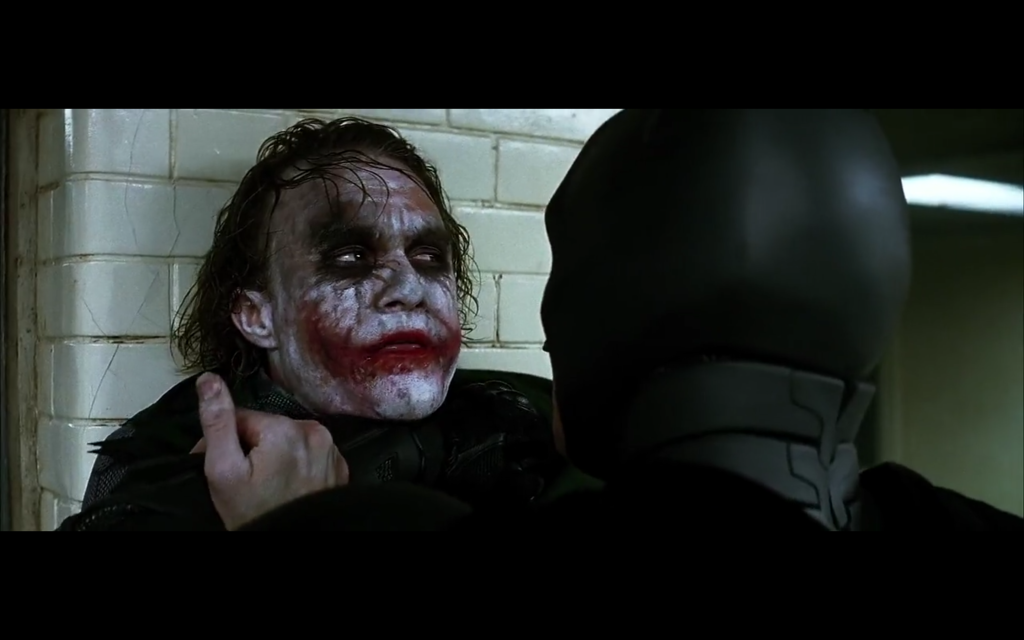
Look at the stills from the interrogation scene in ‘The Dark Knight’ for a vital continuity mistake:


When Batman holds Joker up against the wall, Joker’s hands are holding Batman’s forearms upside down – from underneath.


When the frame changes his hands are now on top of Batman’s forearms,


then it cuts back and his hands are under again.

This is poor continuity and something that can be avoided during the storyboarding process. 

You don't need to be a brilliant draughtsman to avoid continuity errors, you just need to know what to look out for and indicate them on the storyboard. Maybe you can't wait to get filming and doing the fun stuff like acting but put a lot of work into the pre production and you will reap the benefits at the edit stage of the process.


Camera Angles 

The same scene can be shot in a variety of ways, each can covey a different feeling for the audience – camera angles are the main things responsible for this. 
Different placements of cameras can make the same action look more dramatic or less dramatic, depending on its placement : flat, angled, eye-level, tilted up, tilted down, bird’s eye, worm’s eye etc. 
Storyboards are the first time the written word becomes visual.
So, the storyboard artist should use the camera angles wisely, the work done here sets the tone for whole piece.
A lot depends on the feeling the writer and the director want to convey to the audience and shot types need to be considered carefully.
In addition, a sequence can become confusing if too many angle changes are used for no real reason.


(Hobbit – An Unexpected Journey, 2012, Peter Jackson) High angle shot is used to emphasize how small Bilbo Baggins feels (and is) as compared to the grandeur of his surroundings.


(Matrix, 1999, The Wachowski Brothers) Remember how weak and desperate Mr. Anderson felt when he was talking to Morpheus on the telephone just before he was captured by the agents? Don’t you feel that claustrophobia and anxiety with this high angle shot?


(Citizen Kane, 1941, Orson Welles) One of the most important pieces of cinema history, Citizen Kane, is well known for its low angle shot scenes. Welles uses these shots during the movie to make the audience feel the change of confidence and power in Kane. These shots are less frequent in the beginning, suggesting him to be equal to his peers. As the movie continues, nearly in every scene we see a low angle shot of him. 
The example above is taken from the election speech scene, an excellent example of the subject. 
The scene starts with a distant shot of him, picturing him more or less about the same scale as the others. 
As Kane continues with his enthusiastic and furious speech, the camera pans down to the bottom of the podium, making him seem very tall. Now almost same size with the giant portrait behind him, Kane is a powerful man, superior to everyone else in the scene.


(Inglourious Basterds, 2009, Quentin Tarantino) 
One of Tarantino’s trademark shot types, showing the characters from below. Notice how dominant, powerful and confident they look from the POV of their victim. 


A low angle shot of The Joker puts him in a position of pwer.


Skyfall - Silva's Opening Speech - rats!


There are only five edits here.
The wide shot sets up the sequence, the lift door seems a long way from Bond who is kept in a confusing, place surrounded by complicated machinery. As Silva gets closer he gets more intimidating.

The close up shows Bond to be processing his thoughts but he isn't afraid. The over the shoulder shot puts the audience next to him, looking up at Silva who has the advantage here.


Tuesday, 4 February 2014

Music video conventions; Andrew Goodwin Theory.


Andrew Goodwin’s Music Video Theory/How to analyse a music video


Key Points;

1 - Relationship between the lyrics and the visuals.
- Themes, mise-en-scene and events of the video match with lyrics of the song, to help to portray the message of the song.

2 - Relationship between the music and the visuals.
- The cuts and edits of the video are in sync with the rhythm and beat of the song matching cuts or effects to specific drum beats or notes.


3 - Music videos have genre characteristics
- Certain features are expected out of a video depending on the genre of the music, for example a girl bands/artists are expected to have dancers and close ups of the singers, whilst a Indi band are expected to have performance shots ofthe band and cut to a fast beat.


4 - Often due to the demands of the record label, artists' videos will include many close ups of the artist and will often develop motifs that recur across multiple videos
- This allows the record label to promote a set image for the band, which will help target audiences empathise with the band.


5 - Emphasis on 'looking'
- The 'male gaze' is often used to attract a male audience. The male gaze is a focus on presenting things that appeal to men. This often means a voyeuristic view of, and an objectification, of women. The emphasis on looking also includes the artist looking directly into the camera helping the audience connect with the artist.


6 - Intertexual references.
- Music videos reference other forms of media, most commonly film, but can also be television and other music videos.

How to analyse music videos;
Andrew Goodwin identifies 5 key aspects of music videos that we, the audience, should look out for;
- Thought beats – Where you ‘see’ in the sound
- Narrative and Performance
- The Star Image
- Relation of visuals to song
- Technical aspects of a music video

‘Thought Beats – ‘Seeing’ the soundStep 1. To look at the music itself. We must take into account the structure of the song.


Step 2. The voice of the song. The artists voice is extremely unique and can form indentification or trademarks that work well with the star image. 


Step 3. Goodwin points out the artists mode of address. Songs can be seen as stories and the artist the storyteller, making the music video a two communication device – them telling us a story and we listening.


Narrative & Performance
Songs fail to give us the complete narrative.
We only tend to get a gist of the meaning of the song and then tend to make up our own idea of what is being told – A negotiated view of a text. (Stuart Hall theory).
Goodwin explains that music videos should ignore common narrative. 
It is important in their role of advertising.
Music videos should include coherent repeatability. 
Narrative and performance work hand in hand its make it easier for the audience to watch over and over without loosing interest.
The artist acting as both narrator & participant helps to increase the authenticity however the lip sync and other mimed actions remains the heart of music videos. 
The audience need to believe this is real.


‘Star Image’The star image is another vital aspect of music videos. Meta narrative which is a big story that describes the development of the star over time, it has an important part to play in the music video production process.


  • Andrew Goodwin stated that there were three different ways in which the music video can connect back to the song itself . These are:
        • Illustration 
        •  

      • Amplification
      •  

        • Disjuncture
  •  Illustration- 
  • Commonly used. 
  • Images illustrate the lyrics.
    • Illustration is the simplest and easiest concept to base amusic video around as it is just a literal meaning to the song’s lyrics in visual form. Owl City have used illustrative ideas in their videos before, for example inFireflies’ when the artist is singing and as he says‘fireflies’ the word fireflies comes up on the screen to alittle toy gadget.
  • Amplification-
  • Amplification is second. The conventions demonstrated by the music video creative director. They may use both performance and narrative, connotations of the meanings. An example of this is Kanye Wests Homecoming where it does clearly show his home but the audience can work out that the song is homecoming and it is him walking around a city that he knows.
  • t
  • Disjuncture - Intentionally ignores the content of the song and genre of the music and tries to create a whole new set of meanings. These music videos dont tend to make a lot of sense and can often use abstract imagery. In fat boy slims “praise you” there is no relation from the video to the lyrics.
Task 1: Analyse Lady Gaga's music video Judas using Andrew Goodwin's Music Theory.


Conventions of Music Videos


  • Conventions of Music Videos Camera 
  • Shots:
  •  Music videos tend to include many long shots, close ups and mid shots. 
  • This is to create emphasis on the artist, location and emotions. 
  • Close ups are used not only to show emotions but to reflect the words of the song with the movement of the lips of the artist. Lipsync.
  • Camera Movement: 
  • The movement of the camera is used to follow and trace the artist or band. 
  • Camera movements include tilts, pans, tracking and crane shots. Tracking shots put the audience in a position where they can relate to the band
  • Mise-en-scene: 
  • This refers to the arrangement of performers and props on stage or in a scene for a production of a music video or any other media text. Mise-en- scene puts importance on the representation of something. 
  • An example is, ‘Mad’ by Neyo: 

  • The mise-en scene involves him walking down a road alone, being in an isolated room. This reflects the isolation he feels from being away from his lover. Also, the props include hats and dark clothes which represent the  mood of the song. Similarly, the lighting is low key. Black and white footage has been used, this connotes an angry and depressed mood. 
  • Editing: 
  • Jump cuts are an editing technique used often in music videos. This technique allows a sudden change from one scene to another. From one place in time to another. 
  • Transitions:  Fades and dissolves are common in music videos;  they create a different effect to cuts. 
  • Other main conventions consist of: Lighting: Some music videos are black and white which help emphasise a particular mood and some videos have artificial lighting which put the artist/s in an enhanced look. Sound: Sound is mainly the vocals or the song but in some cases such as Michael Jackson – Thriller, the producers can make the music video into a short film. Props: These are a vital in aiding to add to the scene and create significance on particular objects or people.
  • 2. Costume: This goes with the scenes in the song and reflects the genre. Costume is an important factor because it has a slight influence on how the viewers will dress because they use some of the celebrities as role models Colour: Colours tend to set the mood of the song through creating an atmosphere. For example, dark colours are used more in rock songs such as Kings of Leon and bright colours are seen to be used more in hip hop and pop videos.
  • 3. Music conventions in Indie/Rock: • Tends to be black and white • The artist/band is shown throughout the video • Use of extreme close ups and long shots are popular • Dark locations • Face paced • Some use of special effects Examples: • Kings of Leon http://www.youtube.com/watch?v=LWhairF_DS8 • The Fray http://www.youtube.com/watch?v=nY2INQnmRyk • Arctic Monkeys http://www.youtube.com/watch?v=30w8DyEJ__0 Music Conventions in Hip Hop videos • Locations tends to be a party, club fancy location • Use of alcohol • Recognised brands and clothing • Expensive cars and houses • Camera shots tend to long and establishing to show the money involved. Close ups to show the jewellery and assets of the artists. • Attractive women • Does not follow a storyline, only follows the genre • Artist(s) tend to be involved Examples: • 50 Cent http://www.youtube.com/watch?v=5qm8PH4xAss • T.I. http://www.youtube.com/watch?v=xK082mbeBZ0 • T-Pain http://www.youtube.com/watch?v=Ui86peQZ74s Music Conventions in Pop videos • Bright and colourful • Close ups to show the cheerful and upbeat emotions • Extreme close ups – these tend to show the purity and innocence in the personality of the artists • Aims at the teenage audience • Very upbeat Examples: • Britney Spears http://www.youtube.com/watch?v=brYTO6JHMHs • Madonna http://www.youtube.com/watch?v=lWTDR6ztcnQ • Alesha Dixon http://www.youtube.com/watch?v=-503QA6F08g